
A Letter Concerning Toleration (1689)
· Two Treatises of Government (1689/90)
John Locke
The journal Comprendre and the SEC's other publications, in print and digital form.
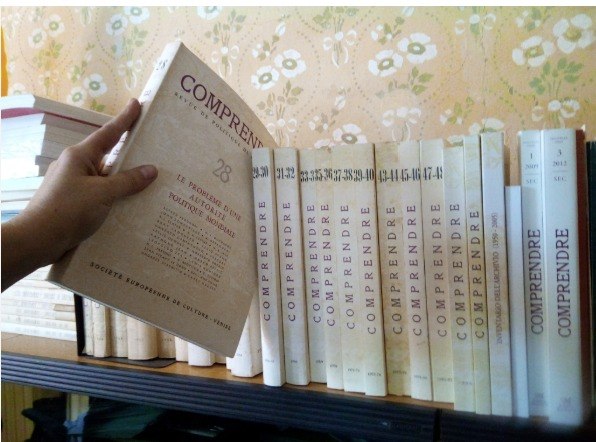
Comprendre is a notable international journal on the “politics of culture” founded by Umberto Campagnolo in 1950 and the official organ of the Société européenne de culture (European Society of Culture). It is currently published by Clueb publishing house, Bologna, Italy.
It boasts a very prestigious history in which several phases can be distinguished.
A first, significant period runs from 1950 to 1988, directed by Umberto Campagnolo (1950-1976) and Norberto Bobbio (1976-1988). The journal carried a subtitle, which changed in time from “Revue de la Société européenne de culture” to “Revue de politique de la culture.” Each volume was marked by a monographic theme within the section devoted to “Les enquêtes de la politique de la culture” which, from no. 13-14 (1955), when the format changed, always opened the journal immediately after the editor’s “Avant-propos.”
Another phase in the history of Comprendre can be identified between 1988 and 2008. Under the editorship of Giuseppe Galasso, there also appeared an additional monographic volume devoted to “L’Europa, la cultura, la pace. A vent’anni da un’eredità spirituale. A cinquant’anni da un’idea: la SEC” (Proceedings of the international conference on Europe, culture and peace dedicated to Umberto Campagnolo, philosopher and politician of culture [1904-1976]), published in 1999, and an “Index général (n. 1-50). Première partie. Auteurs - textes - illustrations,” published in Venice in 2004.
Therefore, for the 150th anniversary of the unification of Italy, a special issue devoted to “Unità degli italiani, unità degli europei,” with articles by Carlo Azeglio Ciampi, Giuseppe Galasso, Remo Bodei, Vincenzo Cappelletti, Valerio Castronovo, Tullio De Mauro, Arrigo Levi, Ida Magli, Gianfranco Pasquino, and Chiara Saraceno, was prepared and distributed via issue no. 44 of 2011 of the weekly journal “Panorama.”
In 2017 the third series of Comprendre was launched, edited that year by Umberto Margiotta, with the subtitle “Revue de politique de la culture,” and the statement on the title page, “Fondée en 1950 par Umberto Campagnolo.” The publisher was Clueb of Bologna. The editorial language was still French, but articles in other languages were also accepted. Following the journal’s tradition, the two issues of 2017 each have a monographic theme. Publication of Comprendre was then interrupted for a few years, partly coinciding with the reorganisation of the European Society of Culture formalised through amendments to its Statute. It resumed as the “third series” in 2025, edited by Lorenzo Franchini who kept the graphic design but gave up the monographic character of each volume, making the journal suitable to host a lively debate on a wider variety of subjects.
The titles of Comprendre from no. 1 to no. 48 are listed at the bottom of this page.
Over the course of its history, the journal has benefited from the collaboration of figures of extraordinary prestige such as (and not limited to), Theodor W. Adorno, Thomas Mann, Bertrand Russell, H. Urs von Balthasar D.P., Antonio Banfi, Karl Jaspers, André Gide, Nicola Abbagnano, Concetto Marchesi, Giuseppe Ungaretti, Pablo Neruda, Georges Friedmann, Arturo Carlo Jemolo, J.D. Bernal, Jean Cocteau, Delio Cantimori, Ugo Spirito, Bertolt Brecht, François Mauriac, Arnold Toynbee, W.M. Macmillan, John Lukacs, Pietro Quaroni.
Catalogue and Inventory of the European Society of Culture’s Fonds: the structure of the fonds, the preparatory documents and the history of the journal founded by Umberto Campagnolo can be consulted directly on the portal of the Historical Archives of the European Union database (search for the classification code “SEC”).
Original titles, in French.
| No. | Title | Year |
|---|---|---|
| Under the editorship of Umberto Campagnolo (1950-1976) | ||
| 1 | Universalité de la culture | 1950 |
| 2 | La culture et la bombe atomique | 1950 |
| 3 | La culture et le rideau de fer | 1951 |
| 4 | La crise de l'art | 1951 |
| 5-6 | Le refus du dialogue menace la civilisation | 1952 |
| 7-8 | La politique de la culture | 1953 |
| 9 | Réalité de l'Europe | 1953 |
| 10-11 | Puissance et culture : Le Nouveau Continent | 1954 |
| 12 | Puissance soviétique, communisme et culture | 1954 |
| 13-14 | L'Empire britannique, problème de civilisation | 1955 |
| 15 | Humanisme, aujourd'hui (I) | 1956 |
| 16 | Humanisme, aujourd'hui (II) | 1956 |
| 17-18 | Civilisation et christianisme | 1957 |
| 19 | L'accession de la Chine au rang de grande puissance | 1958 |
| 20 | L’Inde dans le dialogue des civilisations | 1959 |
| 21-22 | L’entrée de l'Afrique dans l'histoire | 1960 |
| 23-24 | La question internationale | 1961-1962 |
| 25 | La guerre froide | 1962-1963 |
| 26-27 | Religion et culture | 1964 |
| 28 | Le problème d’une autorité politique mondiale | 1965 |
| 29-30 | Coexistence pacifique et dialogue | 1967-1968 |
| 31-32 | L’ONU, les États et l'opinion publique | 1968 |
| 33-34 | La démocratie et la culture | 1969 |
| 35-36 | La contestation dans les limites de la raison | 1970 |
| 37-38 | L’engagement historique de l'homme de culture | 1971-1972 |
| 39-40 | Crise et utopie | 1973-1974 |
| Under the editorship of Norberto Bobbio (1976-1988) | ||
| 41-42 | Guerre et combat moral | 1975-1976 |
| 43-44 | Le sens de l'histoire | 1977-1978 |
| 45-46 | Éthique et politique | 1979-1980 |
| 47-48 | Violence et dialogue | 1981-1983 |
Section being set up. Soon to include: Books · Digital.